



How to Introduce Anal Sex to Your Relationship
Last updated: April 2026 · Written by the Pulse & Cocktails team, reviewed by our in-store…
You’ve probably been thinking about this longer than you’d admit. That’s fine. So has half the country.
Maybe your partner brought it up and you don’t know how to feel. Maybe you’ve been quietly curious for months and haven’t found the right way to say it out loud. Maybe you’ve tried it once, it didn’t go well, and you’re wondering if it’s worth another go.
Wherever you’re starting from, this is the guide we wish more people had before trying to introduce anal sex to their relationship. No innuendo, no pressure, no judgement. Just the things our store staff get asked about every single week, answered properly.
Let’s get into it.
First things first: you’re not weird, and you’re not alone
The UK’s definitive sexual behaviour study is Natsal, run by UCL and the London School of Hygiene & Tropical Medicine. Its most recent published figures (2010–12) found 15% of women and 17% of men aged 16–44 reported having anal sex in the past year, up from 11% and 12% a decade earlier. Among women aged 16–24, around 1 in 3 had tried it at least once, roughly triple the figure from the early 1990s. The next round of the survey (Natsal-4) finished in late 2023, with updated figures expected in the coming years.
The short version: it’s been steadily normalising for thirty years. If you’re curious, you’re sitting squarely in the mainstream. If you’ve tried it once and it’s part of your sex life now, you’re part of a group that’s been growing every decade. And if you’ve decided it’s not for you, that’s also completely normal — roughly 4 in 5 UK adults don’t have it as part of their regular sex life either.
How to talk to your partner about introducing anal sex
The conversation is the hardest part. Most people overthink it, rehearse it, then blurt it out at completely the wrong moment.
Here’s what we’ve learned from years of customers telling us how theirs went, backed up by what organisations like Relate say about sexual communication in long-term relationships: the couples who talk openly about sex are the ones who keep enjoying it.
The wrong moments
During sex. Asking mid-act puts your partner in an impossible spot. They’re aroused, they can’t think clearly, and saying no feels like rejecting you, not rejecting an idea. Nobody’s best decision-making happens here.
As a surprise. Don’t spring it on someone in the bedroom. Consent isn’t a twist ending.
After an argument, or as a “spice things up” rescue mission. If your sex life is already shaky, introducing something new won’t fix the underlying thing. Fix the underlying thing first.
The right moments
Low-stakes, clothes on, no expectations. On a walk. Cooking dinner together. A quiet Sunday morning with coffee. Somewhere you can both actually think.
The phrasing doesn’t need to be clever. Try:
- “I’ve been curious about something and I wanted to talk about it properly.”
- “Would you ever be open to trying…?”
- “I read something that got me thinking. Can I run it past you?”
That last one is useful because it opens the door without putting anyone on the spot. You can share this guide, in fact. That’s exactly what it’s here for.
If they say no, maybe, or “not yet”
All three are valid answers. “No” means no. Drop it, don’t sulk, don’t bring it up again next week in a different costume. “Maybe” is often code for I need to think about it without pressure. Give them space to come back to it, or not.
“Not yet” is the most honest answer many people give, and it deserves respect. Not yet might mean not before we’ve talked about it more, or not before I’ve read up on it, or not before I feel closer to you. Ask what “not yet” looks like for them.
If they brought it up and you’re the unsure one
First: you haven’t done anything wrong by not being immediately enthusiastic. Curiosity is not an obligation. Buy yourself time. “I want to think about this properly, can we talk again in a few days?” is a completely reasonable thing to say.
Then do the reading, think about what would make you more comfortable (solo exploration first? a specific kind of toy? a conversation about what you’d stop at?), and come back to the conversation on your terms. A good partner will wait.
The awkward questions, answered honestly
These are the ones people won’t ask out loud. Our in-store team gets asked them constantly, usually in a very quiet voice, usually with a nervous laugh first. Here are the real answers, the same ones we’d give you across the counter.
Honest answer: sometimes a little, usually not, almost never the disaster you might be picturing.
The rectum isn’t a waste-storage area. Waste passes through it fairly quickly and sits further up, most of the time. A normal bowel movement earlier in the day and a shower beforehand handles the vast majority of cases. If you want extra peace of mind, an anal douche (more on those below) takes it from “probably fine” to “definitely fine.”
The only thing we’d actually tell you to worry about is overthinking it. Your body is a body. It’s doing what bodies do.
Done properly, no. Done badly, yes, and that’s what puts a lot of people off for life after one bad experience.
Pain during anal sex almost always comes down to three things: not enough lube, going too fast, or starting too big. Fix those and the pain usually disappears. If it still hurts, stop. Your body is telling you something. It shouldn’t feel like you’re gritting your teeth. It should feel like a different, new sensation you’re gradually getting used to.
Mild soreness afterwards is normal, the same way you might feel a bit sore after any new physical activity. Sharp or persistent pain isn’t normal. Stop and try again another day with more prep, or speak to your GP if anything feels properly off.
Yes. This one isn’t negotiable.
Unlike the vagina, the anus doesn’t self-lubricate. At all. Using it without lube isn’t brave, it causes micro-tears that hurt, heal slowly, and raise your risk of picking up infections. Use a proper water-based anal lube (they’re usually thicker than regular water-based lube, which is exactly what you want here), and use more than you think you need. Then use more again.
Skip oil-based lubes if you’re using condoms. Oil damages latex. Silicone-based lubes are condom-safe but can’t be used with silicone toys. Water-based is the safe default for almost every combination.
You can’t get pregnant from penetrative anal sex itself, but if semen ends up near the vagina afterwards, pregnancy is still possible. Don’t get casual about it.
STI risk is the more important conversation. The lining of the anus is thinner than the vaginal wall, which makes it easier for infections like HIV, chlamydia, and gonorrhoea to transmit either direction. NHS guidance is clear: use a condom if you’re not in a mutually monogamous, tested relationship. That includes when using toys across multiple partners. Put a fresh condom on the toy each time.
You don’t have to. Lots of people don’t. If you want the extra reassurance, an anal douche is a simple, quick way to rinse the rectum with lukewarm water.
If you do douche, do it an hour or two before, not right before. Your body needs time to settle afterwards. Don’t overdo it. Aggressive, frequent douching can disrupt the gut lining and actually cause more problems than it solves. Once or twice before play is plenty.
How to actually start
If your partner’s on board and you’re both feeling ready, here’s the roadmap. Not a timetable, a roadmap. Take weeks, not minutes.
Start alone. Seriously. Spend some time exploring on your own first, with a finger, plenty of lube, and no pressure to achieve anything. You’ll learn what your body does, what feels good, and what your limit is, all without an audience.
Start external, not internal. The whole area has nerve endings worth paying attention to before anything goes in. Rimming (oral–anal contact), light touch around the entrance, and gentle external pressure all count as anal play. You don’t have to skip to penetration.
Size up slowly. When you do move to penetration, start smaller than you think. A finger. Then the smallest plug in a beginner set. Then maybe the next size up a week or two later. Rushing this is the single biggest cause of “I tried it once and hated it” stories.
Relax, breathe, bear down. The muscle at the entrance (the external sphincter) grips automatically when something pushes against it from the outside. The trick is to relax and bear down slightly, like you’re gently going to the toilet, rather than clenching. It feels counterintuitive. It works.
Aftercare matters. When you’re done, a warm shower, a clean-up, and a proper check-in with your partner. “How was that for you?” is a question couples don’t ask each other enough. Ask it. Listen to the answer. Any toys you used get cleaned properly with a proper toy cleaner, not just a rinse.
If you’re new to any of this, the shortcut is a beginners anal toy kit. They come with graduated sizes so you’ve got your next step ready whenever you’re comfortable.
The starter kit: what you actually need
If you walked into one of our stores and said “I think I want to try this, where do I start?”, here’s what a member of our team would put in your hand. We’ve actually put it together as a bundle, so you don’t have to think about it.
One box. Everything you need. Nothing you don’t.
Inside:
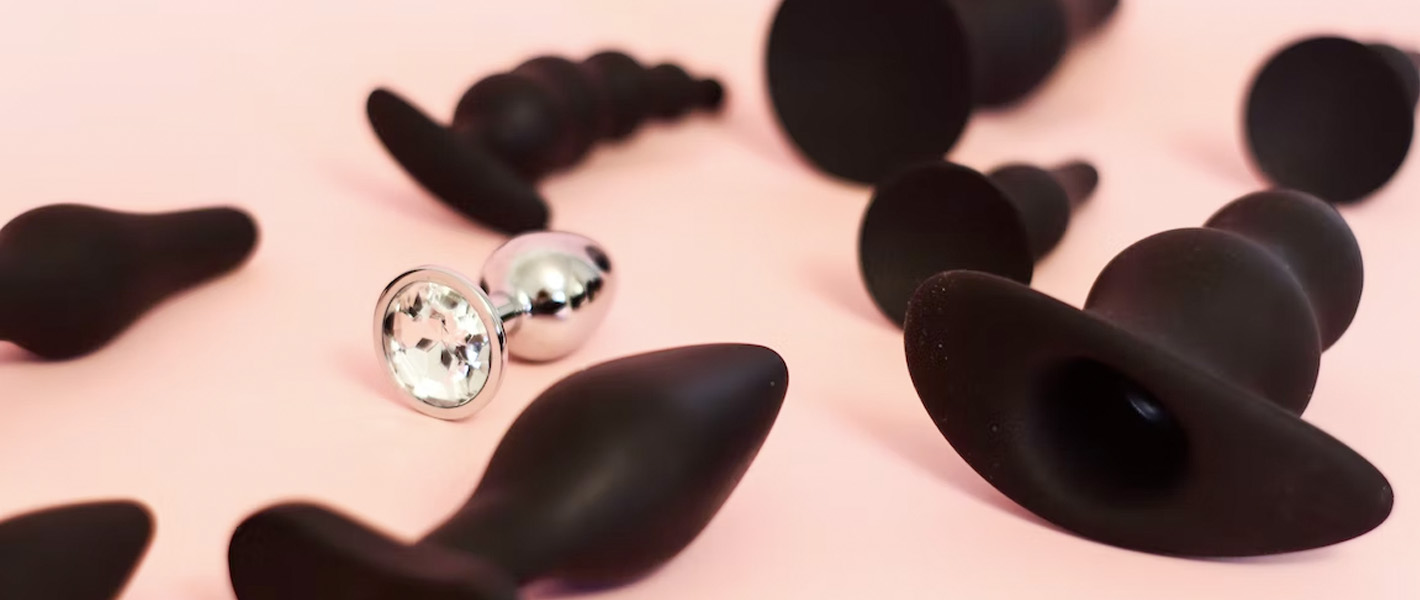
- Mini Black Beginner Butt Plug (3 inch) — soft, body-safe, properly sized for a first-timer. The one to start with.
- Purple Marble Metal Butt Plug (2.5 inch) — your step-up option for when you’re ready, or for people who prefer the weight and temperature of metal. Lots of first-timers end up preferring this.
- A proper water-based anal lube — thicker and longer-lasting than regular lube. Non-negotiable, so we’ve just included it.
- An anal douche — for the “I’d like the extra peace of mind” people. Simple, easy, takes five minutes.
- Antibacterial toy cleaner — because toys need cleaning properly, not just rinsing.
Bought separately, this lot would cost you more. We’ve bundled it at £49.95 because first-timers having everything to hand, ready, is worth a lot more than saving a tenner by forgetting the lube and improvising.
When not to try it
Sometimes the right answer is “not tonight.” A few times when we’d honestly recommend putting it off:
- When you’ve been drinking. Alcohol dulls sensation and makes it harder to notice when something’s going wrong. First-time anal is not first-time-drunk territory.
- When you’re feeling pressured. If you’re doing it because you feel you should, or because your partner’s pushing, stop. Good sex doesn’t come from obligation.
- When your body’s already dealing with something. Active haemorrhoids, a fissure, or recent surgery in the area all need time to heal first. Talk to your GP if you’re unsure.
- When you’re doing it to prove something. To yourself, to a partner, to an ex in your head. Wrong reason. Wait until the reason is genuine curiosity and mutual interest.
None of these are forever. They’re just not now. And “not now” is a completely respectable position.
Aftercare: the bit nobody talks about
The ten minutes after sex matter almost as much as the sex itself. This is especially true with anal play, where the emotional vulnerability can sneak up on you.
Physical aftercare: a warm shower, a pee if you need one (helps flush out anything that could cause a UTI), clean your toys, put on something comfortable. A tiny spot of blood once isn’t usually anything to worry about. It means you could have used more lube, or gone slower. If there’s more than a tiny spot, or it keeps happening, see your GP. Don’t Google it at 2am. Just get it checked.
Emotional aftercare: talk. About how it went, what you’d do differently, what you liked, what surprised you. Good or bad, the conversation afterwards is what turns a one-off experiment into something that can grow into a genuine part of your sex life, or lets you close the door on it amicably if you’re both not into it.
No post-mortem. Just a chat.
Whenever you’re ready
If you’ve read this far, something’s genuinely piqued your interest. That’s great. No pressure to act on it tomorrow, next week, or ever. When you want to take a next step, we’d suggest starting with the beginners anal range and the right water-based anal lube.
If you’d rather see things in person, browse quietly with no pressure, or ask someone face-to-face, find your nearest Pulse & Cocktails sex shop. Our team does this every day. No awkwardness, no side-eye, just straight answers from people who know their stuff.
Whatever you decide, you’ve done the hard bit by reading properly instead of winging it. That’s already more than most people do. You’re fine.